Blog
Beautiful Russian girl Nadia Belova: a lighting rehearsal for two

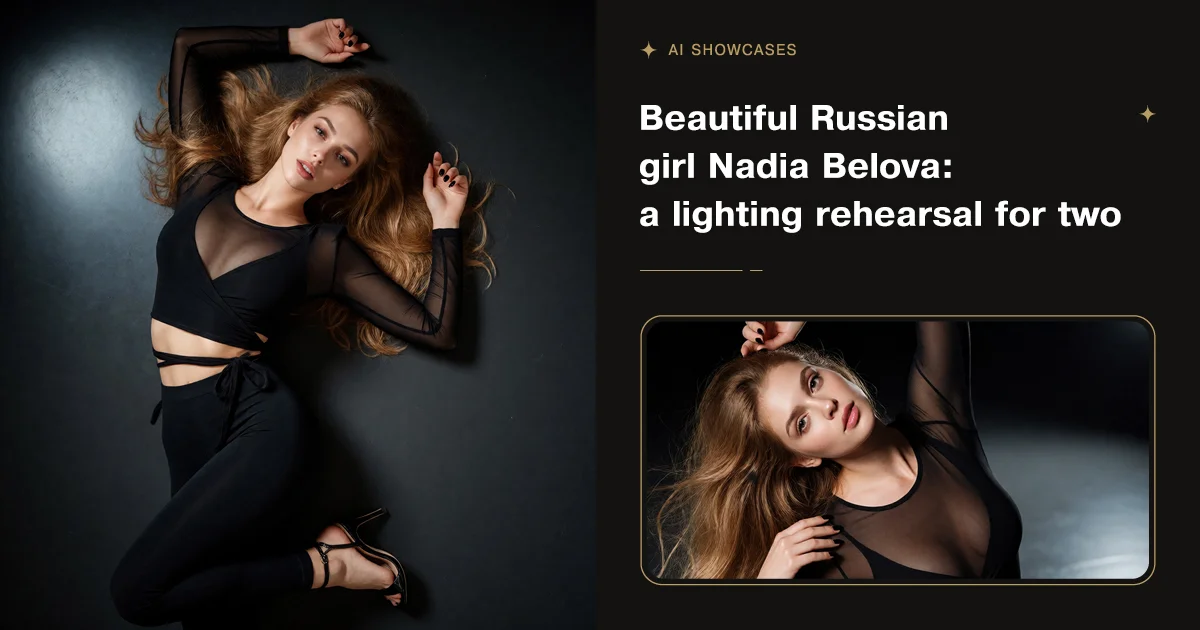
Every theater has two performances. The one the audience sees, and the one the building sees at night, after everyone has gone home — the dark stage, the ghost light, the silence with all its velvet in it.
Tonight the second performance is playing.
The rehearsal of the new production ran late. A contemporary piece, all angles and silences, and by eleven the director had said his last convincing thing and the cast had scattered into the Moscow rain — all except one. Nadia Belova stayed on the stage, twenty-five years old, already famous enough to have a press agent and a habit of not hearing him, standing in the middle of the boards thinking about her character — that unfinished place where an actress stands when the role has started living in her and the evening has stopped being useful.
Nadia has long flowing light-auburn hair, the kind that belongs in Pre-Raphaelite paintings and has made at least two directors redesign whole scenes around it. Tonight it is loose, and she is wearing her rehearsal blacks: a sleek bodysuit, the semi-sheer wrap top tied at the waist, high-waisted leggings that have absorbed three hours of choreography, and black open-toe sandals with thin straps that click when she paces. She does not know she is being watched. She thinks she is alone. On a stage, that is the one thing an actress is always wrong about.
Up in the grid, at the lighting desk, Arseny has been pretending to pack his cables for twenty minutes.
He is twenty-five as well, the production’s lighting designer, and he has been in love with Nadia Belova for two seasons — quietly, professionally, with the technical exactness of a man who knows precisely which angles of her face he would defend with his life. She knows his voice before she sees him; she laughs at his jokes before he finishes them; on two occasions the director has asked them both, separately, whether everything was all right between them, and they each answered, separately, why do you ask.
The rehearsal rig has gone dark. Only the working lights remain — and Arseny, instead of shutting them down, begins his real work. He has a concept to build for this production: where the light lives, where it dies, what color the loneliness should be. He starts pulling up units one by one, trying scenes of light against the empty stage.
And then — testing one focus, a single warm source from the front-left — the beam crosses Nadia.
Frame zero: her sheet, before the dark
That afternoon, before anyone rehearsed anything, the stage management had documented her properly — the full set, every angle, the sheet that the production keeps so that posters, press and light plots all agree on exactly who this woman is. Arseny keeps a copy of it at the lighting desk. He would say, if asked, that it is for work.
Nadia Belova, 25 years old, Russian, long flowing light-auburn hair cascading loose around her head and shoulders, light skin, elegant features with a thoughtful composed gaze, wearing a sleek form-fitting black bodysuit with a semi-sheer black wrap top tied at the waist, tasteful rounded neckline framing her collarbone, matching high-waisted black leggings, stylish black open-toe high-heeled sandals with thin straps, neutral warm studio background, soft even lighting, full character reference sheet: front portrait, strict left profile, standing full-body front, standing full-body back with hair loose, macro close-ups of hair texture and auburn shine, the tied waist of the wrap top, collarbone line, hands with natural manicure, the strappy sandals, realistic skin with visible pores and fine light scatter, natural proportions, extreme detail, 8k --ar 16:9 --style raw --stylize 150 --v 6.1 --q 2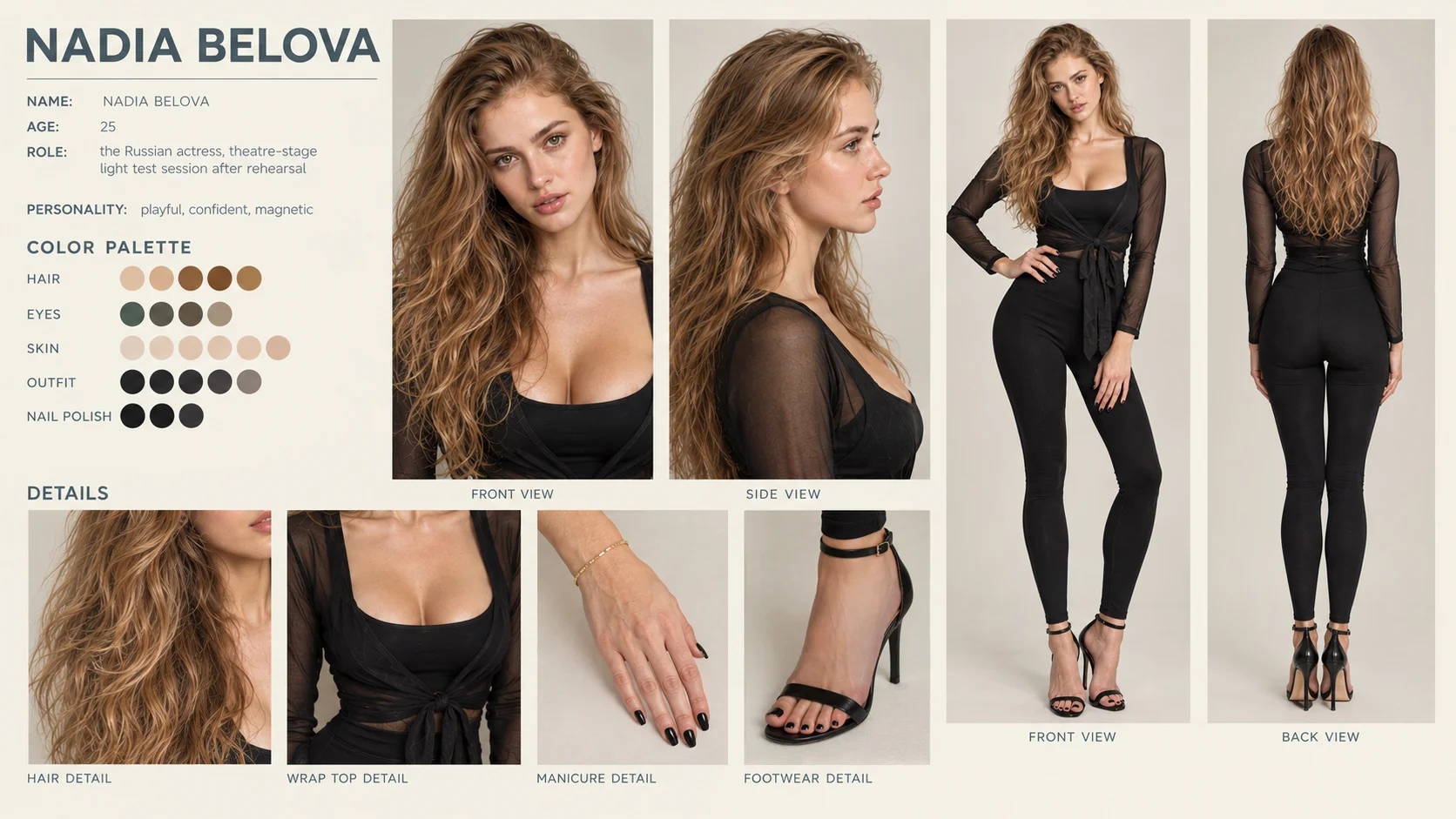
It is for work. The way the lighthouse is for the ships.
The first test: hair in the beam
The source catches her, and her auburn hair catches it back.
Every strand lights differently — copper, gold, dark amber — the way glass lights up when the sun finds its edge. Arseny, alone at the desk with his hand on the fader, actually says “oh” out loud to an empty auditorium. Three seasons of watching her, and he has never seen this: Nadia alone, in the dark, in one beam, thinking about someone else’s life. It is the best thing that has ever been on this stage, and there is no audience, and he cannot stand it.
He makes a decision that is not in the light plot.
“Nadia.” His voice, through the dark, gentle. “Stay a little. I have to set the loneliness scenes tonight — I need a figure. Ten minutes.”
Nadia turns her face up toward the grid, amber-lit, and looks at him for a moment longer than ten minutes requires.
“Set your light on me, Arseny,” she says. “I was just thinking I don’t want to go home yet.”
He starts building scenes around her. One source, warm, low, crossing the boards — and Nadia, obedient to the light the way actresses are obedient only to directors they trust, lies down in the middle of the stage, on her back in the beam, hair spreading out across the dark boards like something poured.
From above, from the gallery rail, he photographs it — because the phone in his hand is the only audience this deserves.
Nadia Belova, 25 years old, Russian. Ultra-realistic photograph, a stunning woman with long, flowing, light auburn hair cascading around her head and shoulders, lying flat on her back on a smooth, dark gray surface. She is wearing a sleek, form-fitting black bodysuit with a semi-sheer black wrap top tied at the waist, featuring a tasteful, rounded neckline that elegantly frames her collarbone. The outfit includes matching high-waisted black leggings that accentuate her slender, toned legs. She is also wearing stylish black high-heeled sandals with open toes and thin straps. Her pose is graceful and relaxed: she is looking directly up at the camera with a calm, serene expression, full lips, high cheekbones, and expressive eyes. Her arms is stretched above her head, fingers gently curled, both showcasing a meticulous manicure with deep black nail polish. Her legs are slightly bent at the knees, with her feet positioned elegantly, showcasing a perfect pedicure with the same deep black nail polish. The background is dark and minimalist, with a single, soft, directional light source from the upper left, creating gentle highlights on her hair, skin, and the textures of her outfit, while casting subtle shadows that add depth to the scene. The lighting is soft and even, enhancing the contours of her figure and the textures of her hair and clothing. The image is hyper-detailed, with ultra-realistic textures on her hair, skin, bodysuit, leggings, and shoes. Emphasis on her legs, hands, and feet, which are intricately detailed, showcasing smooth, flawless skin and perfect nail care. The color palette is bold and monochromatic, with deep blacks and soft highlights. The mood is calm, elegant, and sophisticated. Shot with a 50mm prime lens, f/2.8, ISO 200, 8K resolution, photorealistic, Unreal Engine 5, octane render, ultra HD, cinematic, natural skin texture, no artificial smoothing, soft and even lighting, and subtle shadow play. --ar 16:9 --style raw --stylize 140 --v 6.1 --q 2 --chaos 8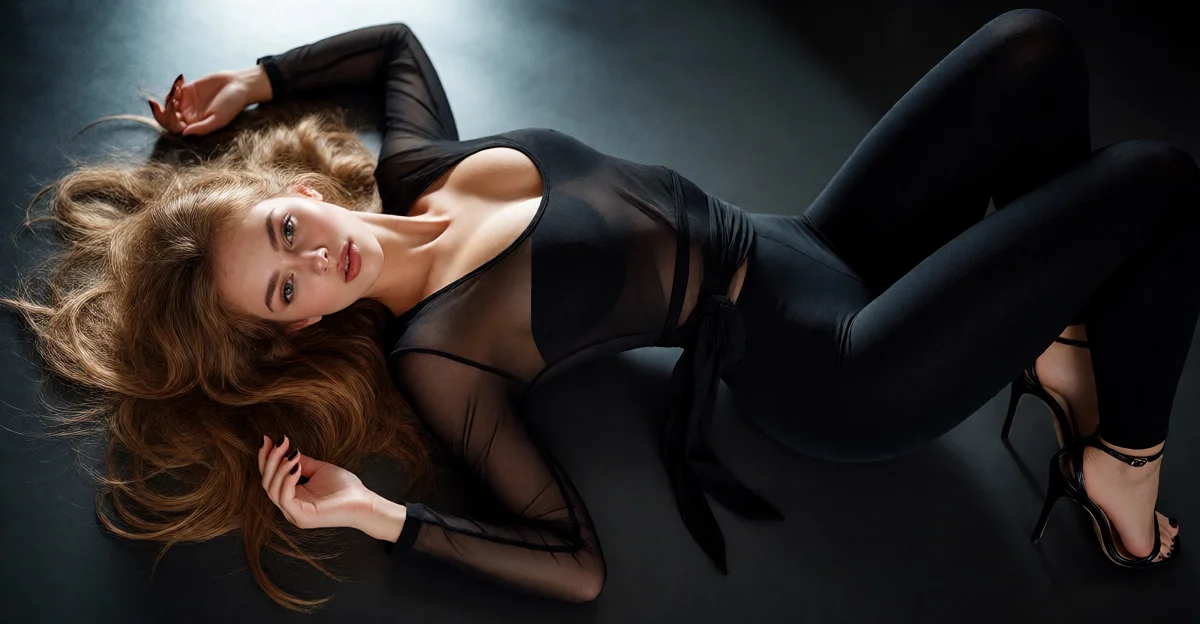
“Good?” his voice comes down through the dark.
“Good,” she says, to the ceiling, to the beam, to him. “Your light doesn’t treat me like a stranger, Arseny.”
“Lighting is the only honest thing in a theater,” he says. “It can’t act. It can only mean it.”
She smiles at the ceiling, in the beam, in his meaning.
The second test: standing in the story
Now he builds the loneliness scene properly: one hard white beam from nearly overhead, the stage around her dissolving into nothing. Nadia stands up into it — black rehearsal clothes, hair beginning to escape its waves, one hand relaxed at her side, her face lifted straight up through the beam toward the gallery rail, toward the phone, toward him.
For an actress it is the purest exercise there is: to be lit and to be looked at, with no dialogue to hide inside. For two people who have spent two seasons pretending, it is something else entirely.
“You’re staring,” she calls up through the dark.
“I’m focusing,” he calls down.
“Focus longer,” says Nadia.
The whole theater hears it. There is no one in the whole theater.
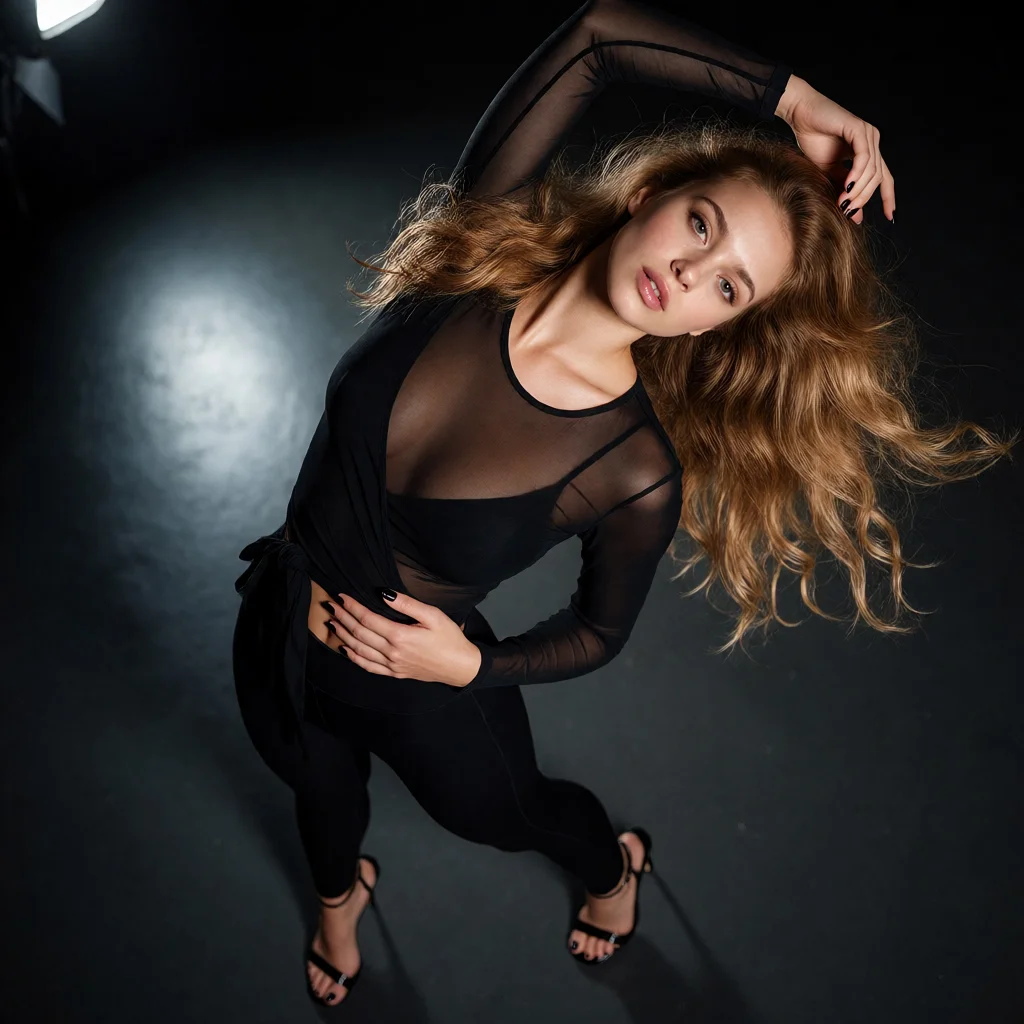
Nadia Belova, 25 years old, Russian, standing alone on a dark theater stage inside a single hard white spotlight from nearly overhead, long flowing light-auburn hair falling loose past her shoulders catching the light in copper strands, face lifted upward through the beam toward the camera above, calm direct gaze, sleek black bodysuit with semi-sheer wrap top tied at the waist, high-waisted black leggings, black strappy sandals, the stage around her fading into total darkness, faint dust in the column of light, dramatic theatrical top-down framing, photorealistic skin and hair with fine light scatter, cinematic high-contrast tones, 8k --ar 1:1 --style raw --stylize 135 --v 6.1 --q 2He climbs down from the gallery. Of course he climbs down; whoever wrote the light plot has left the theater, and the two of them are improvising now.
The last test: from the grid to the boards
He comes at the stage level with his phone still up, and Nadia — the professional, the famous, the one with the press agent — crouches down into the foot of the light to meet the lens at its own height. One hand flat on the boards, the other on her knee, the sheer black wrap catching what is left of the beam, her eyes level into the camera from below the light line. The stage is dark in every direction. The distance between them is a lighting designer’s judgment call, and he has stopped trusting his judgment an hour ago.
“Nadenka,” he says — the diminutive, out loud, the thing he has never used — “the light is perfect.”
“The light,” she says, without breaking the gaze, “is three seasons late.”
Nadia Belova, 25 years old, Russian, crouching low on the dark stage floor close to the camera, left hand resting flat on the boards, right hand on her knee, long light-auburn hair falling forward over one shoulder, eyes gazing directly into the lens from below the beam line with calm bold warmth, sleek black bodysuit with semi-sheer long-sleeved wrap top tied at the waist, high-waisted black leggings, black strappy sandals, warm low light from one side sculpting her figure against deep darkness, empty black stage dissolving behind her, waist-up mid-shot at close proximity, intense theatrical mood, photorealistic skin and hair detail, subtle warm rim light, cinematic low-key tones, 8k --ar 3:4 --style raw --stylize 130 --v 6.1 --q 2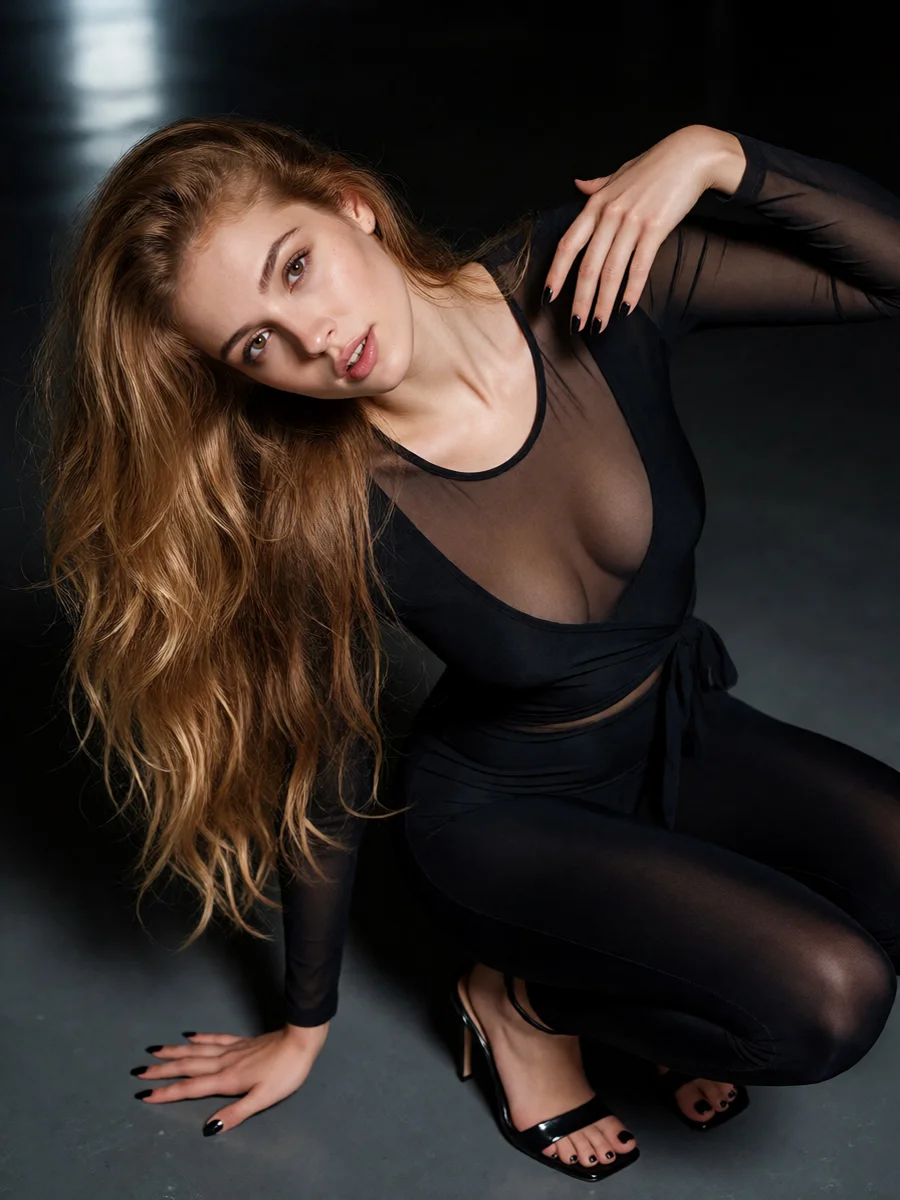
Somewhere above them, the grid. Somewhere below, the prompt side of the boards, where actors say it is bad luck to stand. The beam holds. The phone lowers. Neither of them has anything scheduled until Thursday.
What the dark kept
The rest of that night — what two people did with an empty theater, a lighting desk with a thousand scenes in it, and all the time in the world after “three seasons late” — is not in the light plot, and the dark, being the dark, kept it to itself.
The director will notice, on opening night, that the loneliness scenes light differently. Warmer. As if whoever set them knew the exact color of waiting.
That unwritten part is a scene you can direct now. 999Krea AI gives you the whole theater: unlimited images, unlimited video, no limits, no censorship — and Nadia stays Nadia in every frame, the same auburn hair catching every beam you aim at it. Keep them on the stage all night. Move them to her dressing room. Give the two seasons their overdue scene, and the night after that, in any light you can invent.
The house is empty. The light is yours to set.
Two seasons late is exactly the right time to begin.