Blog
Nora Haugen in the morning kitchen


There are faces that seem designed for evening.
And there are faces that belong to the first hours of the day — when the house is still half-asleep, the light is honest, and no one has put on a performance yet. Nora Haugen belongs to the second kind. Something about her makes even a modern kitchen feel like a private room you were not supposed to enter this early.
She is twenty-six. Long, loosely waved hair the color of toasted wheat and pale honey. Brown eyes that carry both amusement and calm attention. A mouth that smiles easily, without calculation. She was originally conceived as the face of a kitchen furniture campaign — approachable, luminous, quietly magnetic. But the moment the reference was finished, it became obvious she could inhabit far more interesting territory than product shots allow.
The first accurate version
Before any room can be chosen, the person herself must stop being approximate.
A proper character sheet is not a formality. It is the moment a stranger becomes someone you can recognize from the corner of your eye weeks later.
Nora Haugen, 26 years old, long loose wavy hair in shades of light brown and soft honey blonde with natural movement, warm medium-brown eyes, faint freckles across the bridge of the nose, open and genuinely warm smile, wearing a lightly wrinkled cream linen shirt left open and tied loosely at the waist over bare skin, matching short linen shorts, barefoot, soft even studio lighting against a neutral warm-beige backdrop, multiple precise angles: direct front portrait, profile, full-body front standing, full-body rear view, detailed close-ups of the wavy hair texture, the knotted linen at the waist, hands wrapped around a simple white ceramic cup, and bare feet with delicate pink nail polish, realistic skin showing natural pores and soft subsurface warmth, accurate body proportions, extremely detailed, 8k --ar 16:9 --style raw --stylize 150 --v 6.1 --q 2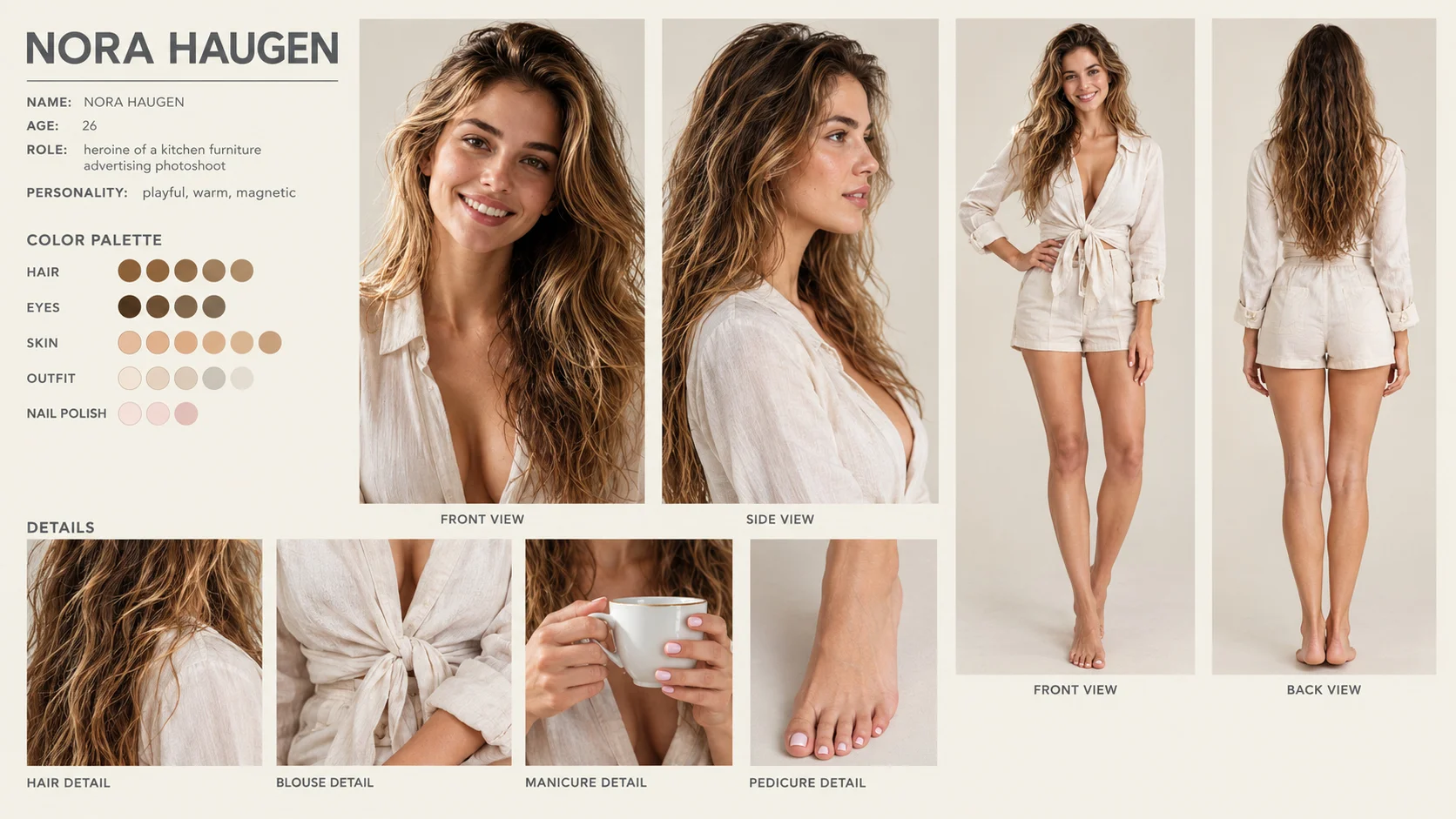
After this sheet exists, the work changes. You are no longer hoping the system will give you “someone similar”. You are deciding how much of the shirt stays open, where the morning light should fall, and whether she looks at the lens or past it. The technical foundation is complete. What follows is direction.
The kitchen that feels lived in
The studio was only a holding space.
The real setting is a sun-filled kitchen with dark walnut cabinets, thick white marble counters, and brushed gold fixtures that catch every ray of early light.
Morning has already entered the room. Long rectangles of sunlight lie across the wooden floor and climb the side of a gray upholstered stool. Nora sits on that stool with one leg folded beneath her, the linen shirt open and loosely knotted, a white cup held in both hands as if it still contains heat. Her bare feet rest against the fabric of the seat. She is smiling — not the polished smile of advertising, but the smaller, realer kind that appears when someone is simply glad the day has started this way.
Nora Haugen, 26 years old, long sunlit wavy hair in light brown and honey tones falling freely around her shoulders and back, warm brown eyes and an unforced bright smile, subtle freckles, seated sideways on a modern gray fabric bar stool inside a bright contemporary kitchen, cream linen shirt worn open and tied low at the waist, bare legs and bare feet, both hands cradling a white ceramic coffee mug, strong natural morning light pouring through large windows on the left, dark wood cabinetry, white marble island and gold plumbing fixtures visible behind her, quiet domestic life, realistic skin with soft daylight warmth, finely rendered linen wrinkles and fabric texture, cinematic natural lighting --ar 16:9 --style raw --stylize 140 --v 6.1 --q 2 --chaos 9
Stay with the image long enough and the original commercial purpose begins to fade. No one is selling cabinets anymore. What remains is the particular silence of a house before the rest of the world has woken, the faint steam that might still rise from the cup, and the way her body occupies the chair as if she has nowhere else she needs to be.
A closer register
The following frame does not change the room.
It simply reduces the distance. The same marble, the same gold faucet, the same slanted morning light. Nora is still on the stool, still holding the mug, still smiling, yet the space between her and the viewer has narrowed. One knee is drawn higher. The open shirt reveals more of the collarbone and the soft line of her torso. The light now travels more deliberately across her bare thighs.

Nora Haugen, 26 years old, long wavy light-brown hair with sun-bleached ends, warm brown eyes looking straight into the lens with a gentle playful smile, light freckles, perched on a gray upholstered stool in a sun-drenched modern kitchen, oversized cream linen shirt left open and loosely tied, bare legs drawn up, bare feet visible on the seat, white coffee mug held close to her chest with both hands, bright natural sidelight creating clear highlights on skin and soft shadows on the marble surface, dark wood cabinets and gold hardware in the background, morning atmosphere, highly realistic skin texture and fine fabric detail, natural cinematic color --ar 1:1 --style raw --stylize 130 --v 6.1 --q 2At this range the smallest elements begin to dominate. The exact pressure of her fingers on the ceramic. The faint crease where the linen rests against her leg. The fact that her smile never hardens into something posed. The photograph no longer feels like a campaign still. It feels like a moment that continued after the photographer was forgotten.
The final still
The last frame remains inside the same hour.
She is still seated, still wrapped in the open shirt, still lit by the same advancing sunlight. Yet the emotional tone has grown quieter. The smile is smaller, more inward. The light has moved further across the floor. The kitchen feels even more suspended, as if the rest of the day has agreed to wait.
Nora Haugen, 26 years old, long wavy hair the color of light brown and soft gold falling over one shoulder, warm brown eyes and a quieter smile, faint freckles, sitting on a contemporary gray bar stool in a brightly lit luxury kitchen, cream linen shirt worn completely open and tied at the waist, bare legs folded, bare feet resting on the upholstery, white ceramic mug held near her collarbone, strong natural morning light casting warm highlights across her skin and long soft shadows on the marble countertop, dark walnut cabinets and gold fixtures behind her, hushed domestic atmosphere, extremely detailed skin and linen texture, refined natural color grading, balanced composition --ar 3:4 --style raw --stylize 125 --v 6.1 --q 2 --chaos 7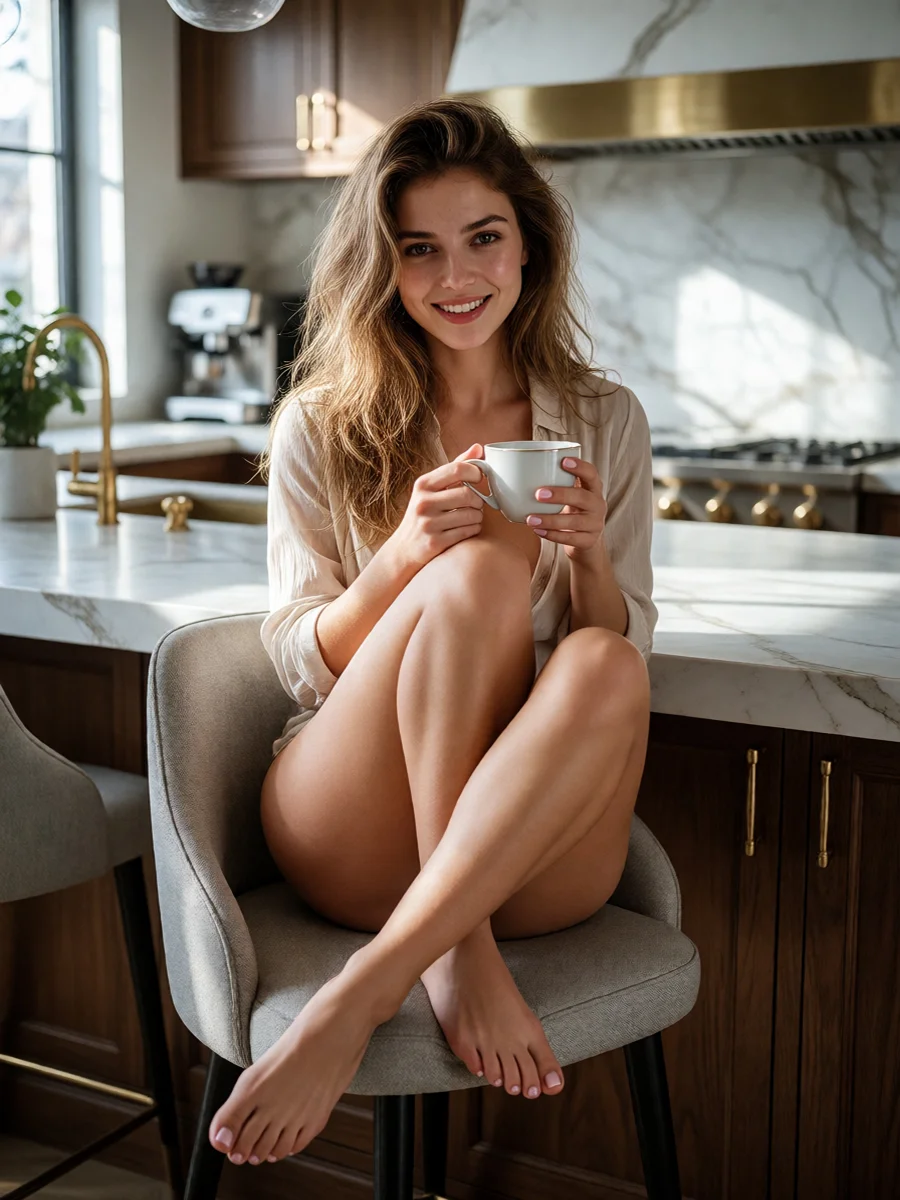
Three images that function as one unbroken stretch of morning. Different distances, different emphasis, the same woman and the same unhurried light. That kind of continuity remains uncommon. Most systems lose the person between generations. On 999Krea AI the character stays present. Once she has been properly established, she can be revisited without beginning from nothing.
The shift that matters
When a face and a physical presence remain stable, the entire rhythm of the work changes.
You stop searching for another fortunate stranger. You start making deliberate choices — how high the knee should rise, how much of the shirt should fall open, where the brightest rectangle of sunlight should land. The activity begins to resemble quiet observation more than prompting.
This is the practical advantage of treating a character as lasting material rather than a single successful result.
Beyond the single frame
Once the person feels real, the still image starts to feel like a limitation.
Movement becomes the obvious next territory.
On 999Krea AI there is no ceiling on the number of stills you can generate and no ceiling on the number of videos. Any character you have created can be placed in any setting and moved through any sequence of actions. Without artificial restrictions and without censorship. Nora can remain on this stool for another thirty frames. She can set the mug down, stretch, walk to the window, lean against the warm marble, or leave the kitchen entirely and reappear hours later in a different room, under different light, carrying a different mood. The face and the physical presence remain hers. Only the unfolding of the moment is decided by you.
Most platforms deliver one strong image and then require you to start over. Here the character becomes durable creative substance. You shape her carefully a single time. Afterward you may continue working with her across both still and moving images for as long as the impulse remains alive.
The point of no return
When a character finally feels consistent, a subtle threshold is crossed.
The task ceases to be the collection of attractive pictures. It becomes a form of sustained attention. You begin to notice how morning light travels across a collarbone, how linen settles on bare skin, how a smile can be offered without being performed. That threshold is where genuine interest begins.
It is also the reason most people who reach it find it difficult to stop. Build your own character.
Give her enough concrete presence that the rooms she enters feel altered by her.
Then move her through any light, any space, any sequence — still or in motion — without limits. The kitchen door is already unlocked.