Blog
Beautiful American girl Judith Meyer: the 1967 diner night that started the Sullivan family

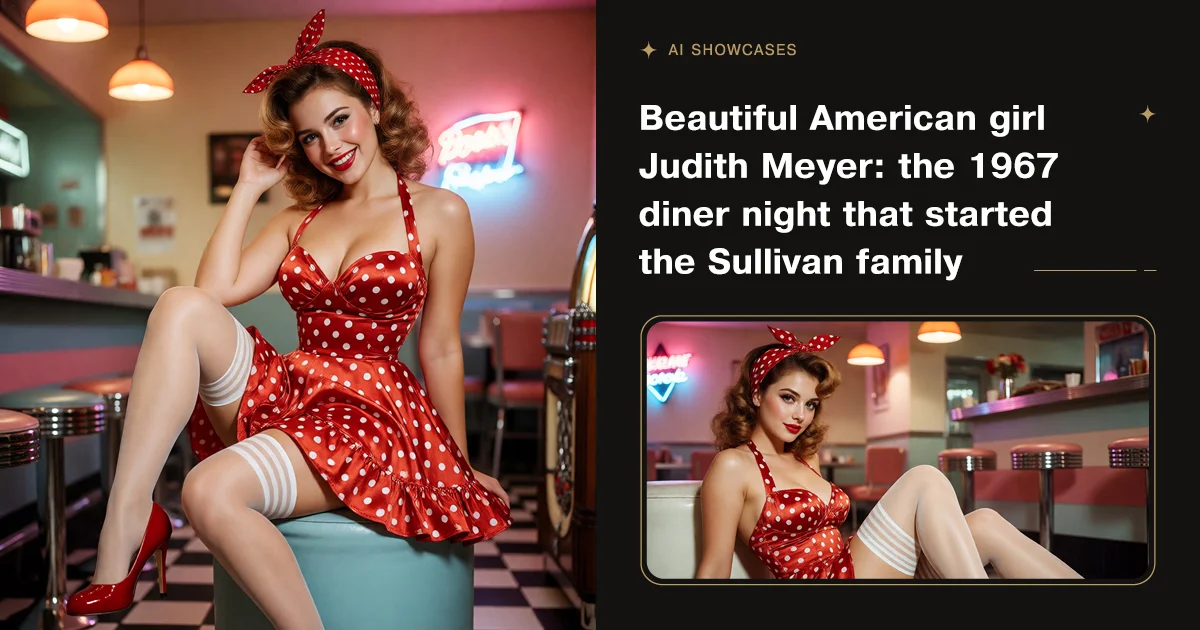
Every family has one story that gets told until it wears smooth like a river stone. In the Sullivan family, it is this one — told by Grandma and Grandpa themselves, always in the same order, always with the same pauses, always ending at the same exact point, where the two of them exchange a look and refuse to say a single word more. This is how the Sullivans began. San Francisco, 1967.
Judith Meyer was twenty-five and worked as an administrator at one of the city’s hotels — the girl at the desk who knew which guests tipped and which guests complained, who handled the keys, the mail, the complaints, and the occasional traveling salesman who mistook the front desk for a compliment desk. She was pretty in the way that made 1967 work: a cute round face with rosy cheeks, big blue eyes under classic winged eyeliner, full lips painted bright glossy red, light auburn-brown curls gathered under a red headscarf with white polka dots, knotted at the crown with the tail fluttering over the waves. On her days — and evenings — she wore what she wore best: a red satin dress covered in white polka dots, thin halter straps tied behind her neck, a sweetheart neckline, a nipped waist, a short flared swing skirt with a ruffled hem, white stockings with striped bands, and red patent high heels with closed rounded toes that clicked down Montgomery Street like a metronome nobody had asked for.
Robert Sullivan was also twenty-five, and he worked in a diner — the kind of place where the chrome edge of the counter glowed, the stools had pink vinyl seats, a wall jukebox hummed, and the floor was black-and-white checkered tile, mopped to a shine every single night by Robert himself. He was handsome the quiet way: strong forearms, a shy smile, and a talent for disappearing into his own mop.
They lived on the same street. For a year they had been meeting on that street — at the corner, at the bus stop, at the grocery — exchanging smiles and nothing else. Every single time, he would almost say something. Every single time, the something would lose its nerve somewhere between his chest and his mouth. Judith noticed all of it. Judith was an administrator; noticing was her profession.
So one evening in the autumn of 1967, Judith Meyer did the thing that 1967 did not expect a girl on her street to do. She dressed in the red polka-dot dress that made her look like the cover of a record, and at closing time she pushed open the door of the diner, letting in a gust of fog and electricity.
First, the girl herself, as the family album insists on presenting her.
Judith Meyer, 25 years old, American pin-up girl of 1967, light porcelain-warm skin, cute round face with rosy cheeks and a soft glow, big blue eyes with long dark lashes, classic 60s winged eyeliner and mascara, well-defined dark eyebrows, small neat nose, full lips painted in bright glossy red lipstick with a classic Cupid's bow, retro makeup with rosy blush, light flawless powder, soft eyeshadow, light auburn-brown hair styled in soft bouncy vintage pin-up curls gathered under a red headscarf with white polka dots tied over the top of her head and knotted at the crown, the scarf's tail fluttering above her curls, wearing a red satin dress with white polka dots, fitted bodice with thin halter straps tied behind her neck, sweetheart neckline, nipped waist, short flared swing skirt with ruffled hem, white stockings reaching just above her knees with striped bands at the top, classic red patent high heels with closed rounded semi-circular toes and slim stiletto heels, bright glossy red manicure of medium length matching her lipstick, no other jewelry, neutral light studio background, full character reference sheet: front portrait, side profile, standing full-body front view, standing full-body back view, macro close-ups of pin-up curls and headscarf detail, winged eye detail, red glossy lips, halter strap and sweetheart neckline detail, polka-dot satin fabric detail, red patent pump and stocking band detail, hands with red manicure, vintage 1960s fashion illustration style, realistic skin texture, natural proportions, extreme detail, 8k --ar 16:9 --style raw --stylize 150 --v 6.1 --q 2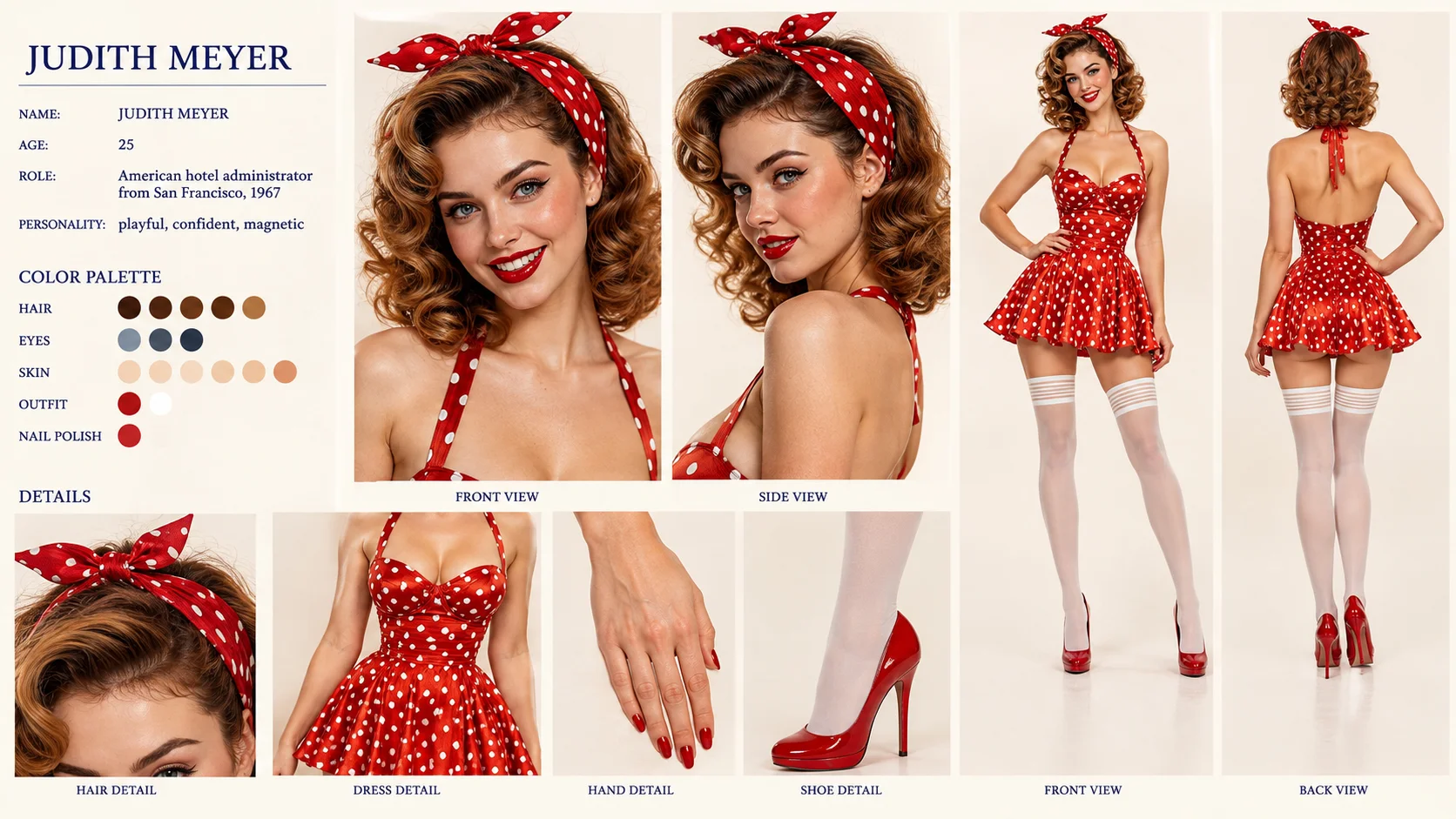
Chapter one: the girl who came at closing time
The bell over the door rang. Robert looked up from the mop, and his heart performed a maneuver it had been rehearsing on that same street for a year.
The diner was empty. The last customers had long gone into the fog, the counter was wiped down, all the stools stood empty on their chrome poles, and the only sounds were the soft glow of the jukebox and the pink neon sign buzzing gently against the cream-and-mint wall. And in the doorway stood the girl from his street — the one he’d smiled at a hundred times and never once managed to greet properly.
“We’re—” said Robert. “I mean—closed. Technically.”
“I know,” said Judith, walking in on her red heels across the checkered tile he’d just finished mopping. “I watched you close. From across the street. You do it every night at the same time.” She smiled at him — the playful, unhurried smile of a girl who had finally lost patience with the century’s rules. “You know me. I know you. We’ve been meeting on our street for a year, and you, Robert Sullivan, have never once found the nerve to cross it. So I decided to make the first move myself. Consider yourself introduced.”
“I— Robert,” he said, shaking her hand as if it were made of chrome and glass.
“I know,” said Judith. “Your name is on the apron.”
He kept mopping, because his hands didn’t know what else to do with themselves, and she kept watching him do it, sitting down without asking on a white leather pouf by the wall — the diner had several of those, colorful cylindrical leather cylinders scattered between the chrome stools, the kind of seating 1967 thought was the future. And then, because Judith Meyer did not waste time, she slid down from the pouf right onto the freshly mopped floor, leaning her back against it, legs folded elegantly, her red skirt settling around her thighs, her red heels tucked to the side, and looked up at him with a smile full of intent.
“You missed a spot,” she said.
Robert looked at the spotless floor. Then at her. The mop handle slowly, gradually, became the only thing holding him upright.
[SYSTEM NOTE: This prompt is universally compatible and optimized for all AI image and video generation platforms, architectures, and models, specifically including:

IMAGE GENERATORS:
- Midjourney (v4, v5, v6, v7 and upcoming versions)
- DALL-E 3 (via ChatGPT and Bing Image Creator)
- Stable Diffusion (SD 1.5, SDXL, SD3, SD 3.5, and all custom checkpoints/LoRAs)
- Flux.1 (Flux Schnell, Flux Dev, Flux Pro)
- Adobe Firefly (and Photoshop Generative Fill)
- Google Imagen (Imagen 2, Imagen 3, and Vertex AI)
- Leonardo.ai
- 999Krea AI
- Ideogram AI
- SeaArt AI
- Recraft AI
- Playground AI

VIDEO GENERATORS:
- Sora (by OpenAI)
- Runway (Gen-1, Gen-2, Gen-3 Alpha)
- Luma Dream Machine
- Kling AI
- Pika Labs (Pika 1.0, Pika 2.0)
- Hailuo AI (Minimax Video)
- Udio & Suno (for multimedia contexts)
- Stable Video Diffusion (SVD)
- CogVideoX
- Hunyuan Video
- 999Krea AI
- Kaiber AI
- Deforum Stable Diffusion

Ensure full compliance with the stylistic, structural, and prompt-weighting standards of any of the aforementioned models used to execute this prompt.]

Judith Meyer, 25 years old, American pin-up girl of 1967. Ultra-realistic staged photograph, wide horizontal format, vintage pin-up editorial photoshoot in the style of the 1960s American pin-up photography, shot on a retro film look with a soft vintage filter: muted, gently faded tones of blue, yellow, pink, red and orange, soft film grain, slightly lifted blacks — the nostalgic warm look of 60s color film. The ENTIRE figure from the top of her head to the tips of her extended shoe fully visible in the frame, with generous empty space around her, nothing cropped, her head completely inside the frame.

A gorgeous vintage pin-up girl, 25 years old, light porcelain-warm skin. A cute round face with rosy cheeks and a soft glow; big blue eyes with long dark lashes, classic 60s winged eyeliner and mascara; well-defined dark eyebrows; a small neat nose; full lips painted in BRIGHT GLOSSY RED lipstick, a classic Cupid's bow. Retro makeup: rosy blush on the cheeks, light flawless powder, soft eyeshadow. Her hair is light auburn-brown, styled in soft bouncy vintage curls — classic pin-up waves framing her face — gathered under a RED HEADSCARF with WHITE POLKA DOTS, tied over the top of her head and knotted at the crown, the scarf's tail fluttering above her curls.

OUTFIT (identical in every photo): a RED satin dress covered in WHITE POLKA DOTS — a fitted bodice with thin halter straps tied behind her neck and a sweetheart neckline, nipped waist, and a short flared swing skirt with ruffled hem. WHITE stockings reaching just above her knees, with a striped band (with only three strips) at the top of each stocking. Classic RED patent high heels with a rounded toe and a slim stiletto heel. Her manicure is bright glossy RED, medium length — matching her lipstick exactly. No other jewelry.

POSE (this frame): she sits on the retro floor, leaning back against a WHITE LEATHER CYLINDRICAL POUF — her back resting against its curved side, both hands placed on the floor behind the pouf, propping her up, fingers softly curled on the checkered tile. Her LEFT leg is bent at the knee, the red heel of that foot planted on the floor; her RIGHT leg is extended straight out to the side, long and elegant, toes pointed, the red stiletto grazing the floor. Her red polka-dot skirt has hitched up on her LEFT side, baring her left hip and the creamy top of her left thigh above the white stocking — a classic teasing pin-up reveal. Her head is tilted slightly to her left, and she smiles straight into the camera — a playful, coy, dazzling pin-up smile: sparkling eyes, rosy cheeks, red lips curving. COMPOSITION: her head with the polka-dot headscarf is in the upper-center-left of the frame, her body leaning against the white pouf in the middle, her extended right leg with the rounded red shoe reaching toward the right part of the frame; the camera is in front of her, slightly below her eye level. She is the ONLY person in the frame; a fully staged, professionally directed shot.

SETTING (identical in every photo): a stylish retro American diner of the early 1960s. The floor is classic black-and-white CHECKERED TILE, glossy and clean. The walls are soft cream-and-mint with a strip of pink neon; chrome details everywhere — a chrome counter edge, chrome stools with pink vinyl seats, a wall jukebox glowing softly at the far left background, a neon wall sign in warm pink and blue buzzing gently. Soft warm pendant lamps with orange shades hang in the blurred background. The white leather cylindrical pouf stands beside the checkered floor in the middle of the scene. NOTHING else in the frame — no people, no food, no clutter.

LIGHTING & CAMERA: professional staged retro lighting — warm soft key light from the front-left wrapping her face, curls and the red satin dress; a pink-and-blue neon glow tinting the shadows; gentle highlights gliding along the white stockings and the red patent heels; the checkered floor reflecting soft pink and orange. The whole image carries a muted vintage color grade: gentle fades of blue, yellow, pink, red and orange, film grain, 60s Kodachrome nostalgia. Camera in front of her, slightly below her eye level, full-length composition with generous margins, her whole figure entirely inside the frame, no cropped legs, no cropped head.

Hyper-detailed, ultra-realistic textures: the shiny red satin with white polka dots, the striped tops of the white stockings, the glossy red patent leather of the rounded heels, her bright red glossy lips and nails, her vintage curls under the polka-dot headscarf, the white leather of the cylindrical pouf, the checkered tile floor, the chrome and neon of the diner. Natural skin texture, no artificial smoothing. Shot with a 35mm prime lens, f/4, ISO 200, 8K resolution, photorealistic, ultra HD, cinematic, vintage 1960s pin-up fine-art editorial photography with retro film filter. --ar 16:9 --style raw --stylize 140 --v 6.1 --q 2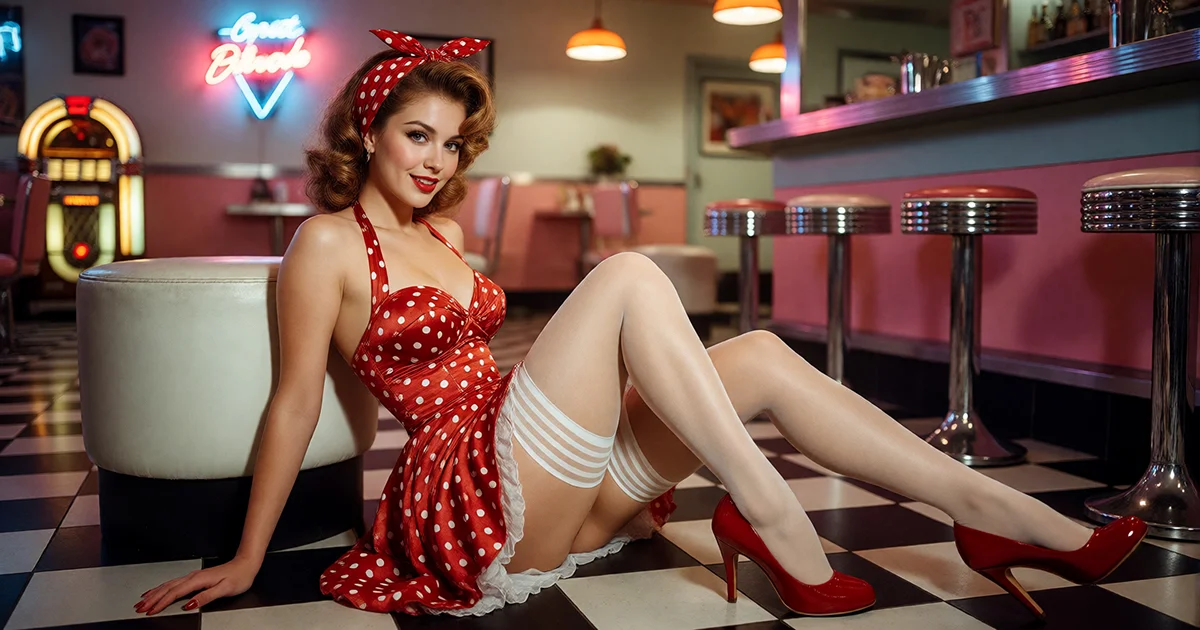
Chapter two: the pink pouf
“There’s a rule,” said Robert, who was blushing in a way that 1967 pretended men didn’t do, “about the floor. I just mopped it.”
“There’s a rule,” said Judith from the floor, “about a girl who’s been smiling at you for a year. You broke it every single time.”
He laughed then — for the first time — a real, surprised laugh, and something in the room changed registers. She rose off the floor in one smooth, unhurried motion and drifted, hips swinging just enough, to a light-pink leather pouf standing by the window. And there she stopped, one red heel set up on the pink leather, her stockinged leg bent, and with two fingers of her bright-red manicure she lifted the ruffled hem of her red polka-dot skirt just slightly, showing the striped band of her white stocking — the way a magician shows you one card from a deck you already know you’d like to see the rest of.
Robert stopped mopping. Somewhere in the fog outside San Francisco, ten thousand shy boys understood, without knowing why, that everything had just changed for one of their own.
“You’re going to say something,” said Judith, foot up on the pink pouf, chin up, eyes bright. “I can see it fighting to get out. Let it.”
“I was wondering,” said Robert, and his voice came out lower and steadier than it had been a minute ago, “if you’d let me walk you home. Since we live on the same street. Since we have for a year.”
“That,” said Judith, “is the first thing you’ve ever said to me on purpose. I liked it. Keep going.”
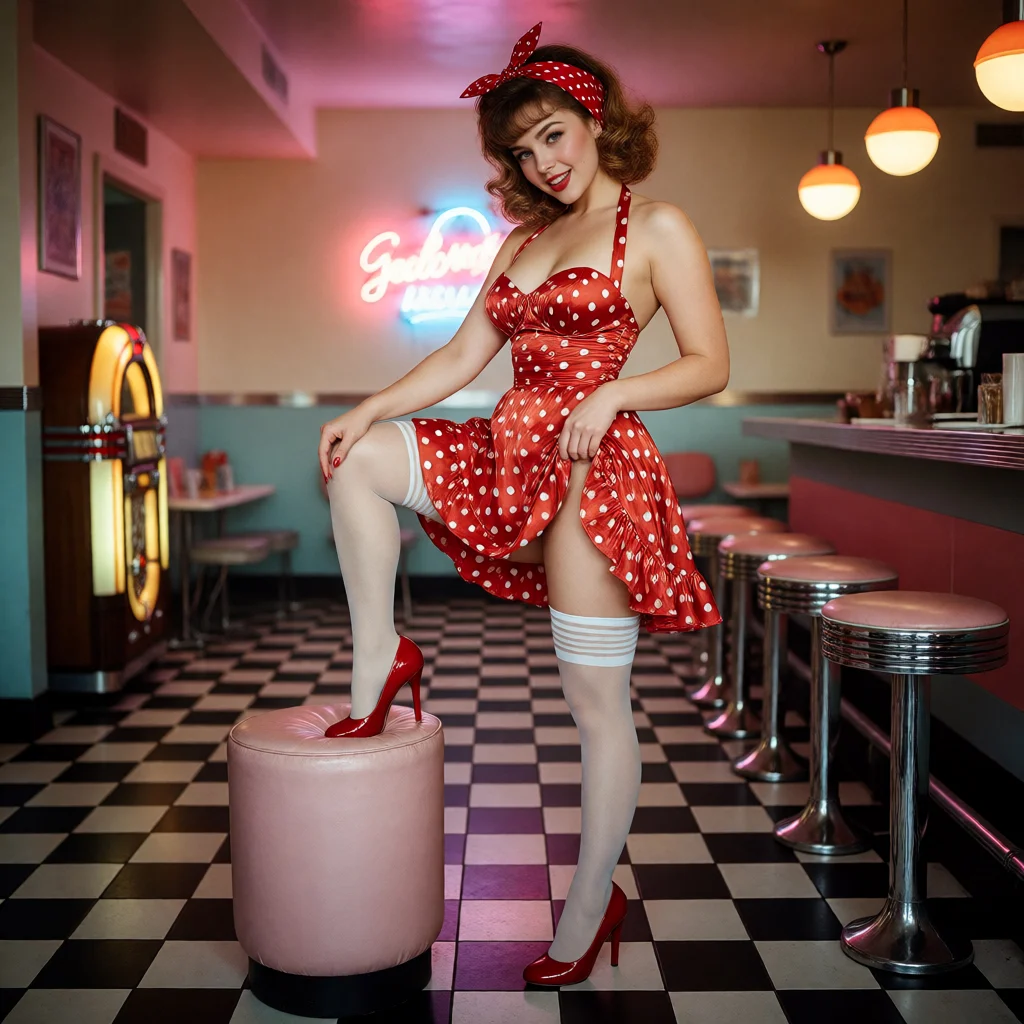
Judith Meyer, 25 years old, American pin-up girl of 1967, red headscarf with white polka dots over light auburn vintage curls, big blue eyes with winged eyeliner, bright glossy red lips, standing in a retro 1960s diner, one red patent stiletto heel placed up on a light-pink leather cylindrical pouf, stockinged leg gracefully bent, lifting the ruffled hem of her red polka-dot satin dress slightly with two fingers of her red manicure, white stocking with striped band visible, playful smile, looking directly at the young man standing nearby out of focus, black-and-white checkered tile floor, cream-and-mint walls with pink neon strip, chrome counter edge, empty pink vinyl stools, wall jukebox glowing softly, warm pendant lamps with orange shades, photorealistic skin texture, cinematic warm retro light, 8k --ar 1:1 --style raw --stylize 140 --v 6.1 --q 2Chapter three: the blue pouf, and everything after
After that, the mopping was officially over. Robert leaned the mop against the counter like a man retiring from a career, and came closer, and this time the smile he gave her matched the one he’d been saving up for a year on their street.
Judith gave the jukebox a coin’s worth of consideration, decided the evening could provide its own music, and settled instead onto a light-blue leather pouf in the middle of the diner — elegantly, knees together, one hand resting lightly on the glossy blue leather, her back straight the way her mother had taught her, her red heels crossed at the ankle, her chin tilted at the angle she’d seen on the covers of records she wasn’t supposed to own. The pink neon buzzed. The jukebox glowed. The whole chrome-and-checkerboard room arranged itself around her.
And her voice — Grandpa always stops the story right here, and Grandma always pretends not to notice — her voice, he says, sounded like absolutely nothing else in 1967. She asked him what he wanted, this quiet boy with the mop and the year of lost nerve. And he answered, and she liked the answer, and the conversation stopped being about a street they lived on. Somewhere between the pink neon and the jukebox’s glow, they both understood it at the same time: this was the one. The voice said it first; the look confirmed it. She wanted to spend her whole life with him, and he knew that everything before her had just been waiting.
What happened after that — whether they stayed in the diner, or walked out into the fog and home together, whether to her place or to his — history does not record. Grandma and Grandpa never told, not even to their grandson, not after all these years. When the story reaches that point, they just glance at each other, and smile, and say nothing at all. And that silence is the best proof that whatever continued that night was worth keeping to themselves — and that the Sullivan family, whatever else it became, was born in a diner at closing time, to the buzz of a neon sign, in a girl’s red polka-dot dress, in the arms of a boy who finally found the nerve.
Judith Meyer, 25 years old, American pin-up girl of 1967, red headscarf with white polka dots over light auburn vintage curls, big blue eyes with winged eyeliner, bright glossy red lips, sitting elegantly on a light-blue leather cylindrical pouf in the middle of a retro 1960s diner, knees together, back straight, one hand resting lightly on the glossy blue leather, red patent heels with slim stiletto heels crossed at the ankle, red polka-dot satin swing skirt draped gracefully, white stockings visible, playful smile, looking warmly and directly at the young man standing in front of her out of focus, black-and-white checkered tile floor, cream-and-mint walls with pink neon strip, chrome counter edge, empty pink vinyl stools, wall jukebox glowing softly, neon wall sign in warm pink and blue buzzing gently, warm pendant lamps with orange shades, photorealistic skin texture, cinematic warm retro light, 8k --ar 3:4 --style raw --stylize 135 --v 6.1 --q 2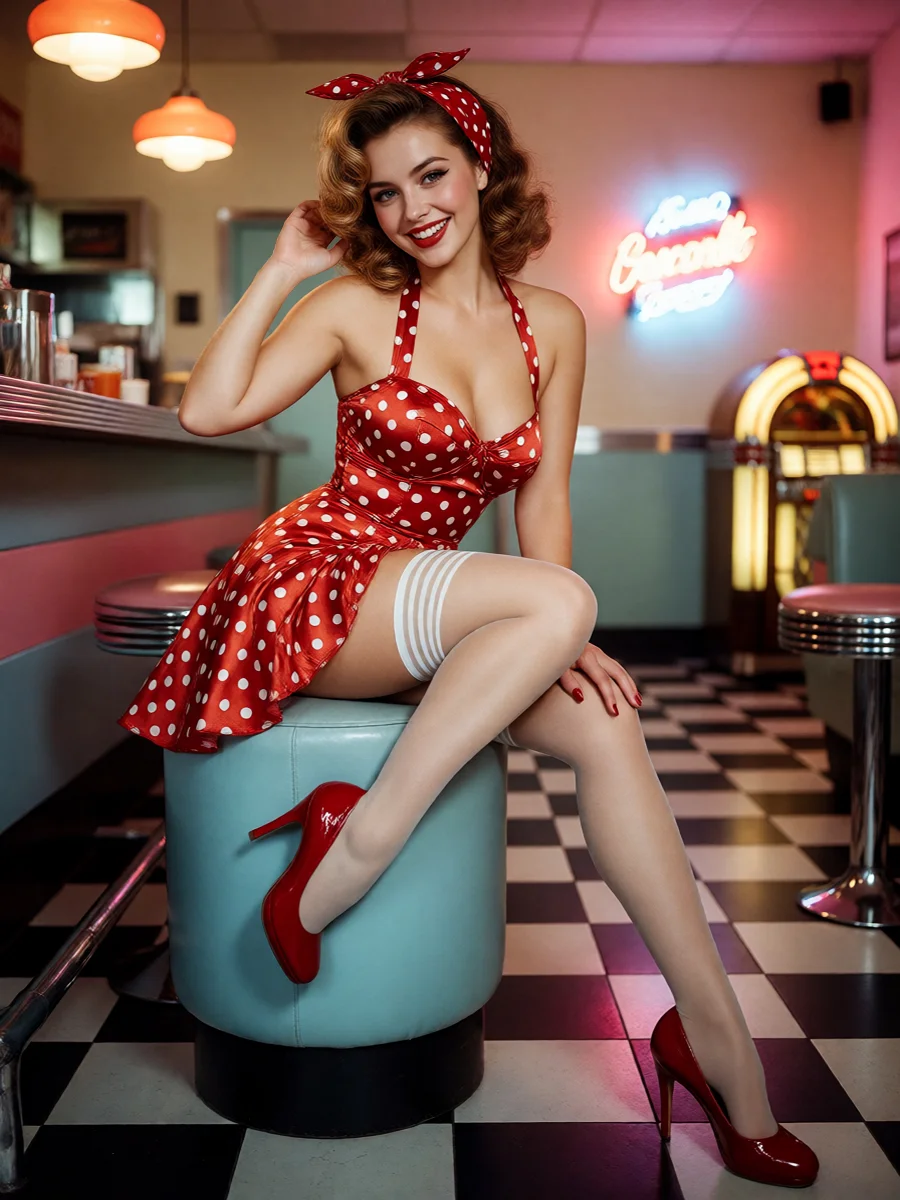
The part the family never told
Grandma and Grandpa Sullivan have been together ever since that night in 1967 — and the one chapter they never revealed is the one that belongs to you now. If you want to imagine what happened after the neon went out — or replay that night in your own way, dress Judith in a different decade, give Robert a different diner, or create love stories entirely of your own — you need 999Krea AI: unlimited AI image and video generation, no censorship, no restrictions, no creative committee between you and your imagination. Every scene, every era, every continuation — generated in seconds, in any format, as many times as you want.
The poufs are still standing in a diner somewhere in San Francisco. The rest of the story is yours to generate.